Happy Hour
转载声明:本文转载自 The Comics Journal,版权归原作者及原媒体所有。
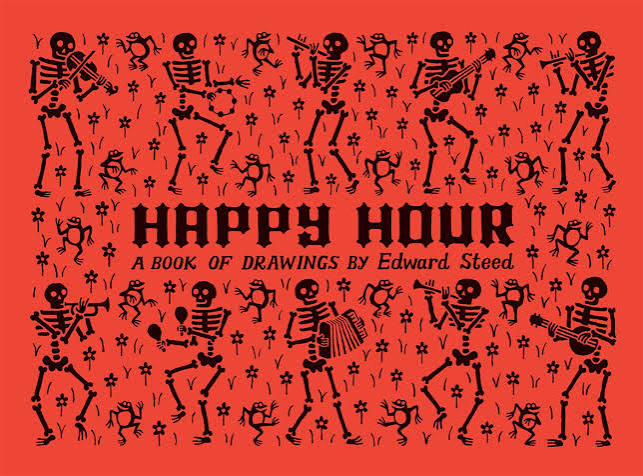
Like all of Edward Steed’s work, the cartoonist’s newest volume is a curious artifact. Humbly subtitled A Book of Drawings, Happy Hour is a collection of mostly single-page gag cartoons originally published in the New Yorker and Esquire , along with a handful of previously unpublished material. Small and unassuming, the book is formatted in the same visual register and cloth binding as Steed’s first Drawn and Quarterly collection, 2024’s Forces of Nature. In this sense, it resembles an endangered species: the latest digest of an individual cartoonist’s recent work, put out in a compact and accessible package as part of an ongoing series of semi-regular installments. Slim, professional, and designed for quick reading, such a digest gathers the ephemeral material of magazines and newspapers within the more stable container of the book, and is intended for display on a shelf thanks to packaging one might well describe as handsome, its quiet dignity forming an awkward contrast with the eccentricity of its contents.
The fact that there is nothing particularly dignified about either Steed’s artistry or his macabre sense of humor renders Happy Hour’s staid exterior a deliberate and frankly hilarious contradiction. Inside the book, one finds sly, transgressive humor on every page — an executioner sweeping severed heads across a barbershop floor, a dominatrix whipping miniature clients who pop up from the holes in a perverse whack-a-mole game, dinosaurs clad in bicycle helmets blithely watching a meteor as it hurtles toward them — with each cartoon contributing something uniquely strange to this catalog of vice and folly. One might expect some repetition in a collection of gag cartoons, and Happy Hour has its fair share of favorite themes: castaways marooned on desert islands, saps in concrete shoes being tossed off piers by sinister mafiosi, couples who find inventive ways to irritate one another. Despite these familiar scenarios, though, the book never falls into routine. In fact, Steed’s greatest skill might be his ability to twist the conventions of the gag cartoon into something entirely different while preserving just enough semblance of the familiar to keep a broad audience interested. Of course many of his scenarios are conventional — show me a gag cartoonist who’s never drawn a therapist’s couch or a fireman’s pole — but Steed’s perspective on them is refreshingly off-kilter; he takes an axe to convention and gives readers a taste of the carnage that results, all while preserving the outlines of convention just enough to make the jokes work. It’s not surprising that he’s become the most distinctive New Yorker cartoonist working right now; no one understands the possibilities and parameters of the single-panel gag cartoon better than him.
Steed’s forte is, for lack of a better descriptor, weird little guys. He takes evident pleasure in drawing humans as fussy, demented gnomes, tiny in stature and bearing emotionally-rich expressions, all of which twist into scowls, grimaces, and grins that communicate malicious intent. Alongside these miniature demons are the innocent, the clueless, and the incredulous, beset by those evil forces that dominate Steed’s landscapes. Steed renders all these figures, pitiless and pitiful alike, within huge, spare environments that remind the reader of just how small they, and we, actually are. Where he draws characters in jagged, splotchy detail, for backgrounds Steed prefers open white spaces, and he describes buildings, interiors, and natural landscapes with a few haphazard lines that are immediately legible as what they are. The effect is one of simultaneous compression and expansion. Comics that might seem claustrophobic are given room to breathe, as incredibly dark humor occurs in the stark light of day.
Happy Hour does have its moments of variation. For instance, while the vast majority of drawings are printed in black-and-white, a few clustered in the middle of the book feature color, albeit sparingly. Here, a sheepish, obviously lying man tries to assuage a giant green asparagus that he doesn’t only visit his friend on National Asparagus Day, while on another page a doctor drenched in blood stands in a hospital waiting room, breaking the news to a weeping woman that the patient he has just left “died of a broken heart.” In these and other images, color makes possible a joke that wouldn’t quite work without it, yet the colors themselves are only minor parts of largely black-and-white cartoons. If Steed seems hesitant to use color in these pages, that may well be because he recognizes that black-and-white is the most flattering option for his work, as it accentuates his inky scrawls where color tends to mute them. That isn’t to deem the color images in Happy Hour unsuccessful, but rather to suggest that their infrequent appearance likely indicates a more fundamental mismatch between vibrant color and Steed’s stark brand of cartooning that can’t be explained away by the fact that the New Yorker rarely allows for color in its cartoons. In other words, it isn’t that his publishers won’t permit the use of color — theoretically, Steed could have stuffed this volume full of color images not published elsewhere — but rather that his comics rarely need it.
It’s worth mentioning that a few of the comics in this collection depart from Steed’s usual work in single-panel cartoons by unfolding sequentially over a series of connected panels. Again, the effect is curious, on the one hand underlining Steed’s strength as a single-panel cartoonist but on the other demonstrating just how formally versatile he can be while still preserving the tonal qualities that make his art so unsettling. The vast majority of the jokes in these multi-panel comics land. In one, a prison inmate spends twelve panels sawing the bars off his window only to water a box of daisies below it in the final frame, while in another two men take turns yelling at each other before a group of spectators until one blows the other’s hat off with the force of his cry, declaring victory and eliciting the crowd’s applause in the final frame. These as well as the volume’s other multi-panel comics are silent, and most take place over a comically long sequence of panels, depending for their humor on excessive, largely fruitless action that builds and builds toward a slow-in-arriving, unabashedly goofy ending. They’re less macabre than Steed’s single-panel offerings, and more conventional too, though one shouldn’t take that as a criticism. Yes, these jokes are sillier, the figures more open and inviting, the punchlines more easily anticipated. But they also, at a fundamental level, work, not despite their conventionality, but thanks to it. The panels create a clear narrative and end in a clear resolution, signaling that, if he wanted to, Steed could easily do a good gag strip, even if today’s syndicates would never actually abide by his subject matter (here I’m thinking of the sequence in which a newborn pops out of its mother, reaches back inside her to retrieve a top hat, and then proudly walks away).
With a collection like this, it’s impossible not to pick favorites. Indeed, that’s one of the advantages of the single-panel format — the best instances of it are more memorable than a multi-panel comic strip. Happy Hour’s humor might not be to everyone’s taste, but those who appreciate Steed’s warped absurdity will find plenty to remember here. My own favorite — and the one that, for me, best captures Steed’s aesthetic — features a man in his basement, caught in the act of putting the finishing touches on what I can only describe as a monstrous, elephantine and elephant-like statue of himself, sewn together with patches and holding in its mouth, inexplicably, a pipe. The woman coming down the stairs casts a wary glance at the man as he laments that “It was supposed to be a surprise.” The cartoon contains so much visual interest, from the mess of tools used to craft this abomination to the three subtle, completely opposed facial expressions (man, woman, monster), but what draws me in every time I look at it is the window in the top left. Utterly useless, it’s a perfect complement to the equally useless statue that absolutely no one will want, and that no one should have created. It’s a pitiable, everyday object trapped in a bizarre scenario — a reminder that Steed’s absurd universe is, unmistakably, our own.