10 Best Far Side Comics featuring Astronauts, Ranked
转载声明:本文转载自 CBR,版权归原作者及原媒体所有。
The Far Side is one of the most popular and famous newspaper cartoons of all time. Largely due to cartoonist Gary Larson's sometimes dark and relatable perspective on life, The Far Side reigned supreme, entertaining and stretching readers' imaginations for over a decade. While Larson's main engine for humor was his perspective on humanity, The Far Side often imagined what other life in the universe would think of our humble species. Space and space exploration have forever been pillars of pop culture, though Larson's understanding of how astronauts are seen by audiences is a bit unexpected.
Growing up during the height of the Cold War and the space race, Larson's cartoons centering on astronauts were his way of showing just how small and silly humans really are. With much of the desire for space exploration originating from a competition between nations, astronauts are the perfect subject for Larson's pessimistic outlook on human nature. Whether encountering aliens or discovering terrifying truths about the universe, the adventures of astronauts on The Far Side are just as strange as they are hilarious.
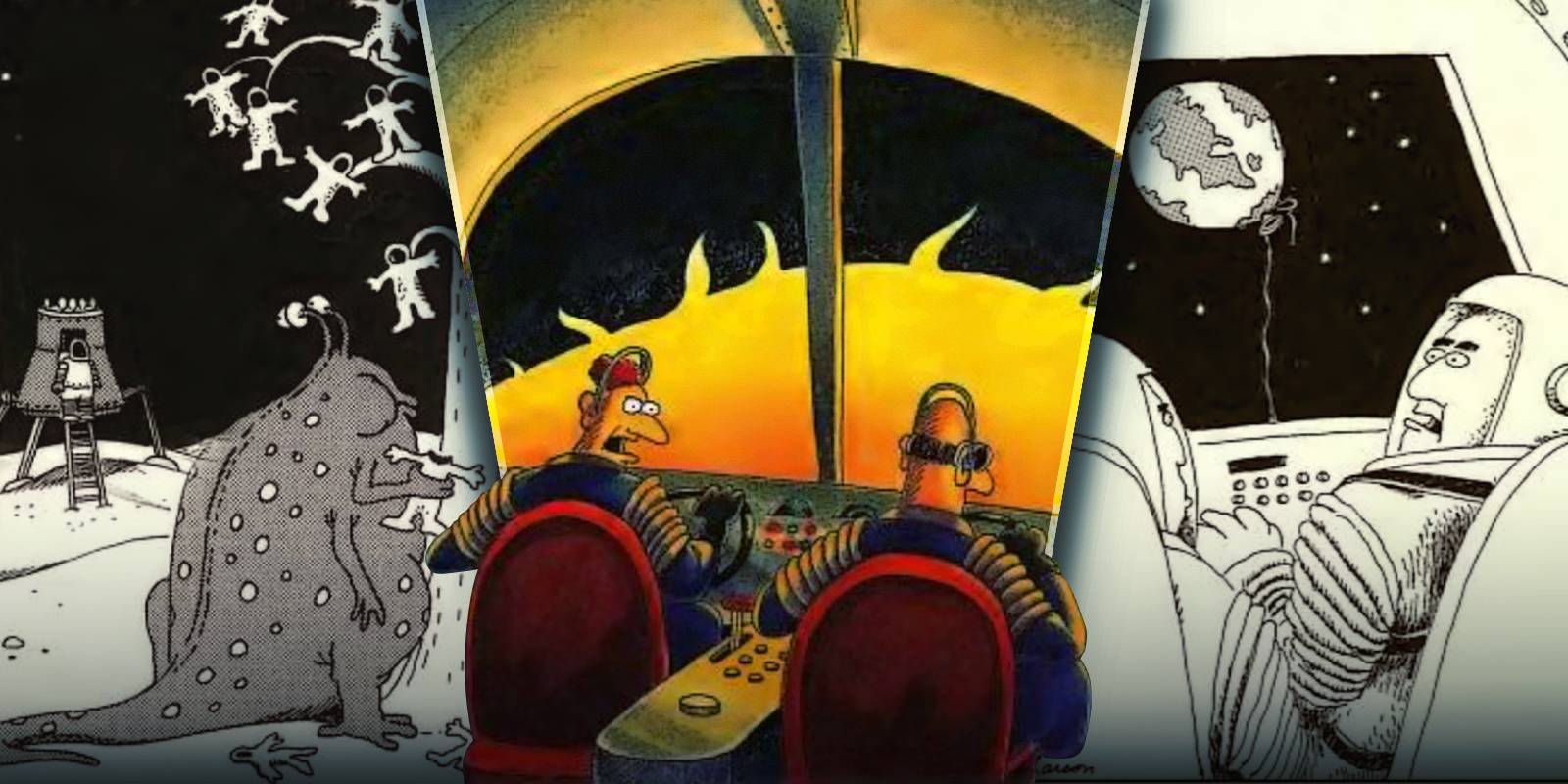
Being the only thing people can actually see in space, the moon has made everyone wonder what secrets it could be hiding. With the possibility of alien life being right next door, this cartoon shows two astronauts' strange encounter with an alien in love. Coming back to their spaceship after exploring the moon's surface, the two astronauts see a giant alien that is the same shape and size as their ship, who has seemingly fallen in love with it.
Often playing with the difference in perspective from animals to humans, Larson uses the same technique with aliens to show how nature is universal. Despite looking drastically different from a human, the alien still shows human traits, such as having a crush, even if it is on an inanimate spaceship. A funny look at what humans' first encounter with alien life could be, love on The Far Side comes in all shapes and sizes.
Among the many recurring themes in The Far Side , Larson's favorite subject was by far human stupidity. Being an admirer of all manner of science, Larson always poked fun at the scientific community. Showing two astronauts who have successfully made it to the moon, one of the astronauts gets a bit too excited and accidentally smashes his partner's face shield when waving his hands in cheer.
Despite having to be pretty smart to become an astronaut, being silly and making dumb mistakes is ingrained in human DNA. A simple but effective use of physical comedy, much of the humor lies in the reaction of the astronauts as one is experiencing the best moment of his life, and the other the worst. It's also hilarious to think of how hard it was for them to get there, only for something so silly as being too excited to be what kills them, showing how humans will typically find the dumbest way possible to ruin their own achievements.
Being the first man to walk on the moon, everyone knows the story of Neil Armstrong and the Apollo 11 mission to the moon. One of, if not the biggest moments in human history, it's not hard to imagine the excitement Armstrong and his fellow astronauts felt when they first landed on the moon. This cartoon depicting the iconic moment shows a race to the finish line between the three crew members of Apollo 11 as they all rush out of the spaceship to try and be first to step on the moon's surface.
There are many wild conspiracy theories about the moon landing, but Larson's may be the best. Sticking to the cartoon's usual themes, Larson shows that even astronauts are not above having excitement overcome in silly ways. The cartoon is even funnier when knowing that Armstrong was chosen to be the first to set foot on the moon over Buzz Aldrin because of his "lack of ego and calm confidence," making the panel a hilarious interpretation of what really happened.
Imagining humans' place in the universe is a question that has plagued the minds of scientists and scholars for centuries. That is, until Gary Larson tackled the issue in 1980. This Far Side cartoon features two astronauts on some sort of space mission when they discover the Earth is just a balloon. As they look in shock at the realization, one of the astronauts looks at the other and says they had better keep this quiet.
One of the funniest theories about where we stand in the grand scheme of things, this Far Side panel hilariously puts humans in their place. Despite the concept being silly, it's actually an interesting depiction of just how much is unknown about our own solar system. The cartoon also has a basis in real-world physics, playing off the Multi-Balloon theory, which explains how the universe is constantly expanding in every direction, similar to air being blown into a balloon.
With films like Alien bringing the concept of terrifying alien creatures into the minds of audiences, The Far Side had its own ideas on what would make alien life scary . Playing on the more common fears of humans, this cartoon shows an astronaut embarking on the harrowing mission of making first contact with an alien species. Being tethered to the spaceship, the astronaut and alien come face to face for him to realize it's a giant spider in a spacesuit, and the caption shows his partners on the ship saying that he must be freaking out, as he even hates spiders.
Often shining a light on mundane universal fears, this Far Side cartoon is a comical pairing of the fear of spiders with that of the unknown. Not only visually funny, but the cartoon also implies that the astronaut was a victim of a prank by his fellow crew members. As the caption implies, he is afraid of everything, even spiders, making it unlikely he would have volunteered to be the one to go out on his own.
Once again taking Far Side readers to the far reaches of space, Larson shows what happens when the search for discovery goes too far. As two space pilots head straight towards the sun, one of the pilots screams that they have been caught in the sun's gravitational field and that there is nothing they can do to escape. However, despite their impending doom, the pilot doesn't let them die before reminding his partner that the sunglasses he is wearing are his.
Showing how people get caught up in silly things despite the real danger right in front of them, the journey for these two space travelers was doomed from the start. Being the biggest planetary body in the solar system, it is absurd to think that two space pilots would be dumb enough to not be able to avoid it. Larson also draws both the spaceship and the pilots differently than he normally does astronauts, which means they are most likely future space travelers, making them even more dumb, as they have perfected space travel but still got caught in the sun.
Known for its dark humor, this Far Side cartoon shows how encountering alien life could turn out to be a bad thing. Featuring a giant alien on some distant planet, an astronaut arrives on the strange planet to see the creature eating from a tree. However, the fruit on the tree looks like little astronauts, and the alien's eyes are fixed on the astronaut as he comes out of his ship.
A scene that could be in the next sci-fi horror blockbuster, this panel is equally funny and grim. With Larson being a naturalist who believes humans are just another part of nature, the idea that plant life on other planets could resemble humans isn't so far-fetched. There are even plants here on Earth that resemble human and animal features, such as the naked man orchid or the narilatha flower in the Himalayas that looks like the face of a monkey.
The early days of space travel were strange, to say the least. While human astronauts like Neil Armstrong get all the credit, it was animals that paved the way for human space exploration. With monkeys being one of the first animals to successfully be sent into space, this cartoon shines a funny light on this weird moment in human history. Showing the journey of one of the first astronaut monkeys, the monkey is seen looking confused in his spaceship while trying to eat a banana through his space helmet.
A simple and funny visual gag, this Far Side cartoon is a great example of Larson's use of situational comedy. While the cartoon seems absurd and silly, it's even more surreal to think this is actually how early space travel was. After the Russians began sending dogs to space, the U.S. had to answer by sending monkeys, with Albert II being the first primate to successfully go to space in 1949. However, these early tests all ended in disaster for the monkey, with only one, Albert the 6th, surviving the return trip but being irreversibly traumatized by the experience. Making light of a serious and dark topic is nothing new for The Far Side , especially when dealing with animals. However, this cartoon also shows the ways people put animals in danger for their own stupid reasons and how early space science was just flying by the seat of their pants.
If there is one thing humans love to do, it's build giant structures and monuments to celebrate ourselves. Whether it be the great pyramids, colosseums, or carving portraits into mountains, history is filled with people making their mark on the natural world. Showing that this is a universal feeling even across the stars, one astronaut in this Far Side cartoon discovers a mountain range with alien faces carved into it similar to Mount Rushmore.
Originally majoring in biology, Larson found a lot of humor in the ways different organisms react to each other and their environment. Whether it be plants, animals, or even aliens, The Far Side gives other species human traits that always lead to comical insights into humans' place in the world and beyond. Larson shows that while aliens would most likely look very different, an intelligent species would most likely still have traits similar to humans, such as building structures to honor people, such as Mount Rushmore. The panel also highlights the common trait of humanity destroying the natural world for its own self-interest and how aliens would most likely do the same.
While many like to think of themselves as the center of the universe, humanity and Earth are just a very small part of an infinite galaxy. Not even being the biggest planet in its own solar system, The Far Side shows just how small the Earth really is . This cartoon shows two aliens flying through space when the Earth splatters across their windshield, and they shout about how gross it is.
A silly and funny idea, seeing the Earth being squashed like a bug puts things into perspective. Showing how the Earth is not really all that special, Larson imagines that the end of the world wouldn't be as spectacular as Hollywood would make it seem. While obviously devastating for humans, the destruction of the world would not affect the universe, just as hitting a bug on the highway does not affect daily life on Earth.